
Whole-House Repiping
Repiping is the job nobody wants and plenty of older houses eventually need. It usually comes up after the third or fourth leak in a year, or when a house that has been patched for decades finally has faucets that barely run. It sounds bigger than it is in many homes, and the way it is done depends heavily on whether the house sits over a crawlspace or on a slab.
Montgomery Plumbing Pros is a referral service. We connect you with an independent local plumber who does repipes; the plumber you hire plans and quotes the job.
When repairs stop making sense
One leak on a pipe that is otherwise sound is a repair. A pattern is different. Pinhole leaks showing up in different rooms, rust-colored water from several faucets, low pressure throughout the house, or a plumber who keeps finding corroded fittings every time a wall is opened all point to supply pipe at the end of its life. At some point, the cost of repeated repairs, drywall patches and water damage passes the cost of replacing the lines once.
A good plumber will look at the pipe in several places, not just at the latest leak, and tell you honestly whether you are looking at a few bad sections or the whole system. If a leak is hidden, finding it first is its own step; see pinhole leaks you cannot pin down.
Galvanized pipe in older homes
Galvanized steel was a common supply pipe for houses built through roughly the middle of the last century, and neighborhoods like the Garden District and Cloverdale have houses from the late 1800s through the 1940s. Some of those homes have been fully repiped; many still have galvanized pipe somewhere, often mixed with copper added during later repairs. Galvanized pipe rusts from the inside, narrowing until the water has to squeeze through, and the threaded joints are where leaks start. Where galvanized meets copper without the right fitting, the joint can corrode faster.
A quick check: scratch an exposed pipe in the crawlspace or near the water heater. Gray metal that a magnet sticks to is galvanized steel. Copper is reddish and nonmagnetic.
Early plastic pipe and fittings
Houses built from the late 1970s into the mid-1990s may have polybutylene, a gray plastic supply pipe that was widely installed and later found to fail without warning, especially at the fittings. If you see gray flexible pipe, often stamped PB2110, coming out of the wall at a toilet or water heater, ask a plumber to look at it. Other plastic and early fittings from that era are fine, but a plumber can tell you what you have.
PEX or copper
Most repipes today use PEX, a flexible plastic tubing. It bends around corners, comes in long runs with few joints, resists scale, and is faster to install, so the job usually costs less and takes less time. It should not be exposed to sunlight and needs to be supported properly. Copper is the traditional choice, lasts a long time and is not affected by sunlight, but costs more and takes longer because every turn is a soldered joint.
Either can be a good job when installed well. Ask which the plumber recommends for your house and why, what fittings they use, and whether the lines will be run as a manifold system with a separate line to each fixture or as trunk and branch. A manifold puts a small valve for every fixture in one panel, so a single toilet or sink can be shut off from one spot, while trunk and branch uses less tubing. Either way, the new lines should be pressure tested before the walls are closed, and you can ask to see the gauge hold.
Crawlspace or slab
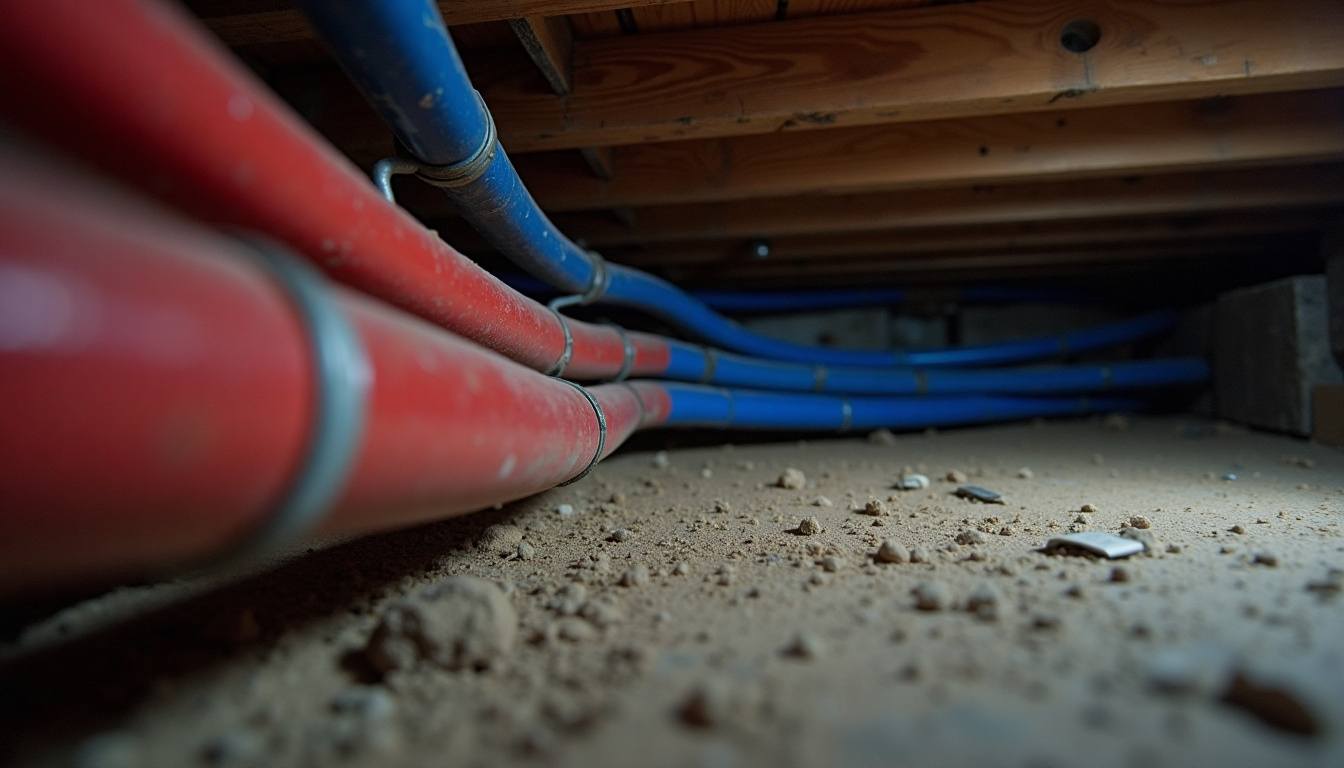
In a crawlspace house, the work happens mostly underneath. The plumber runs new lines through the floor joists and up into each wall at the fixtures, and opens walls only where the pipe has to come up. It is often a matter of days. In a slab house, the old pipes may be under the concrete, so the new lines usually go overhead through the attic and down through the walls, leaving the old pipe abandoned in place. That means more small wall openings to patch, but no broken concrete.
Ask the plumber who handles drywall patching and painting after the job, because some include it and many do not. In the meantime, a house with tired supply pipe is worth knowing well enough to shut off; if a pipe that splits overnight is a worry, find the main valve now. Homeowners in the Prattville area and around the capital ask the same questions.
How a repipe is quoted
A repipe quote depends on the number of fixtures, the number of floors, crawlspace or slab, the pipe material, and how much wall opening the job requires. A good quote lists each of those and spells out what is not included, such as patching, painting or the water heater connections. Ask for all of it in writing before the first wall is opened. Ask about the permit and inspection, how long the water will be off each day, and whether the old main shutoff will be replaced while the plumber is at it.
Talk to a local plumber
Tell us the age of the house, crawlspace or slab, what pipe you can see, and how many leaks you have had, then send the form. If a pinhole leak is spraying now, close the main and leave it closed until a plumber can patch it. We connect you with an independent local plumber who does repipes.